

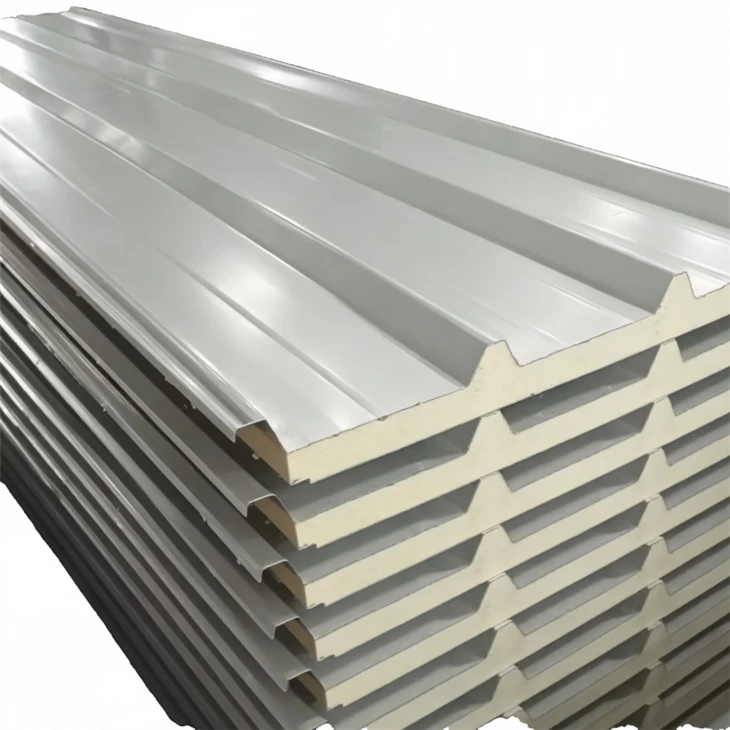
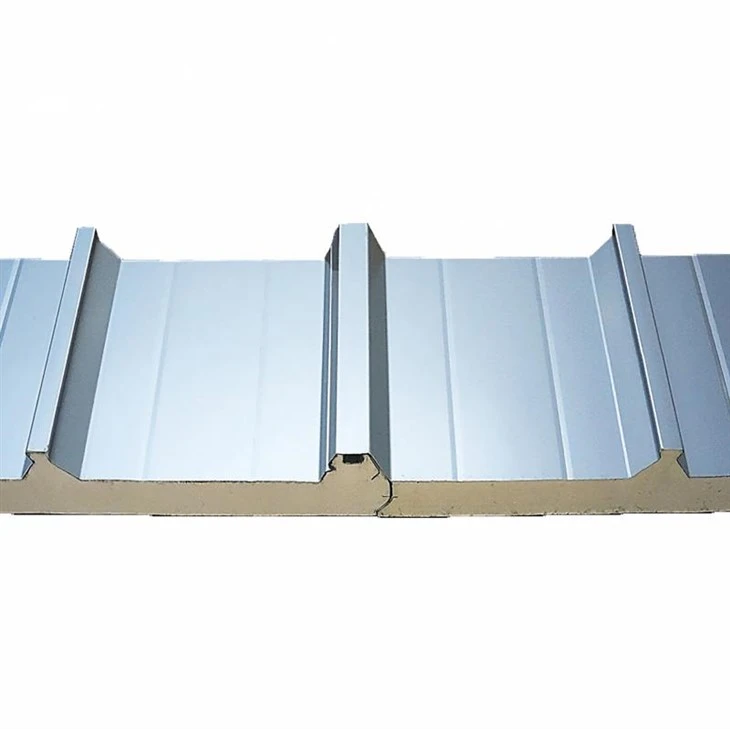
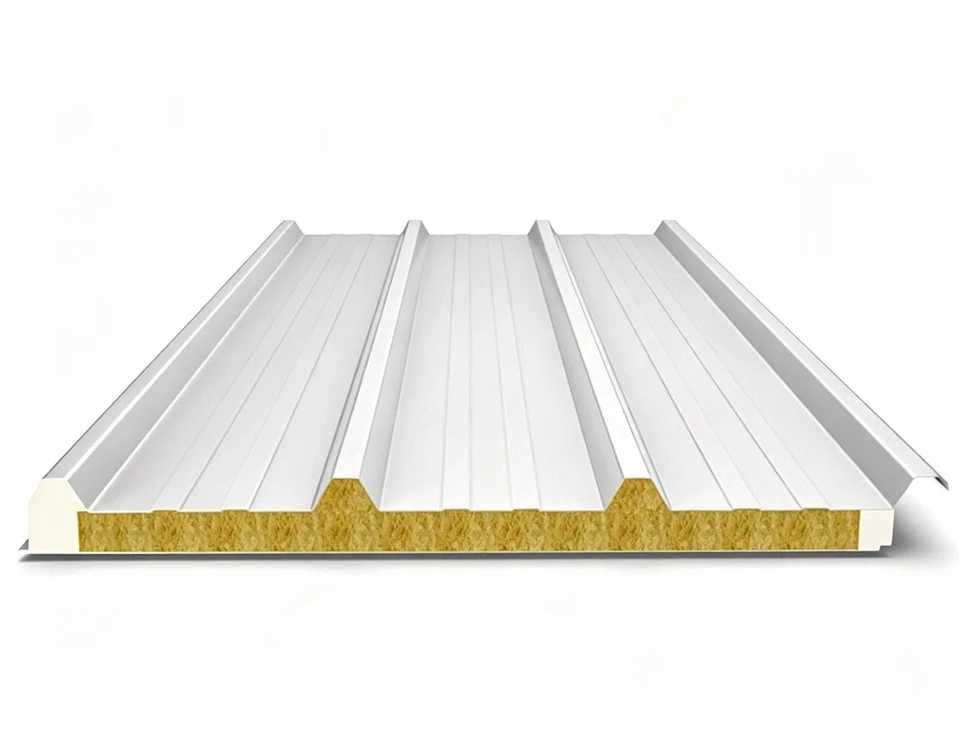
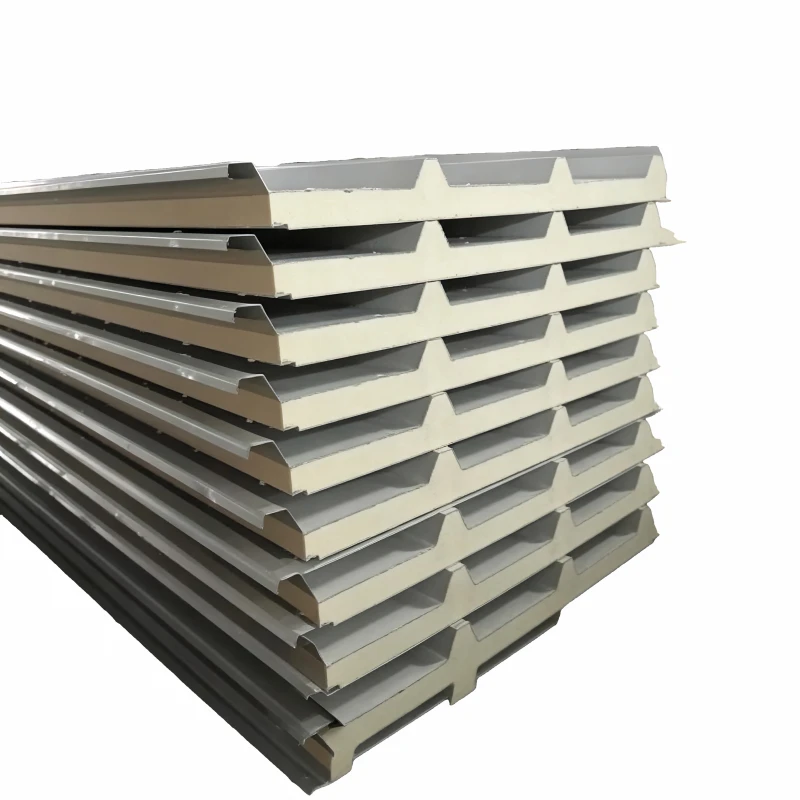
Shenyang Qiangyun Color Steel & Steel Structure Co., Ltd. is one of the most reliable manufacturers and suppliers of puf insulated roof in China. With abundant experience, we are committed to providing high quality customized products with competitive price. Welcome to wholesale advanced puf insulated roof in stock here from our factory. Also, pricelist is available.
Technical Specifications
|
Parameter |
Specification |
|
Product Name |
Puf Insulated Roof |
|
Material |
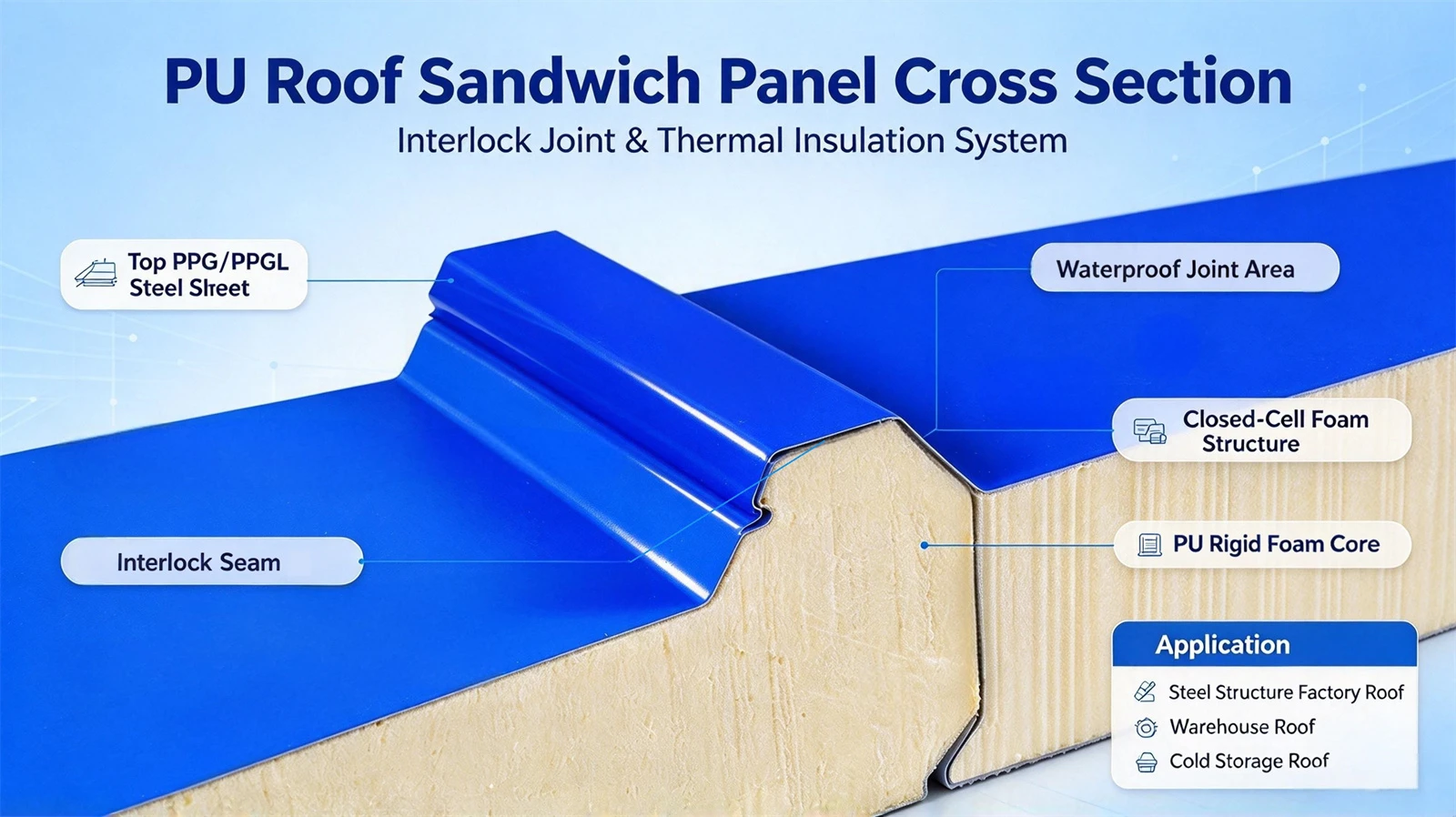
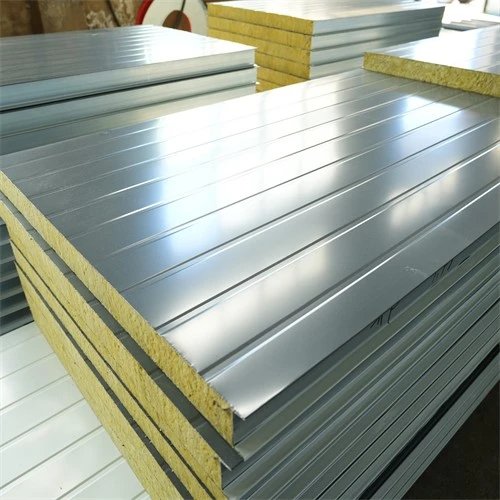
Non-combustible rock wool core + closed-cell PU edge seal, between two metal faces |
|
Surface Material |
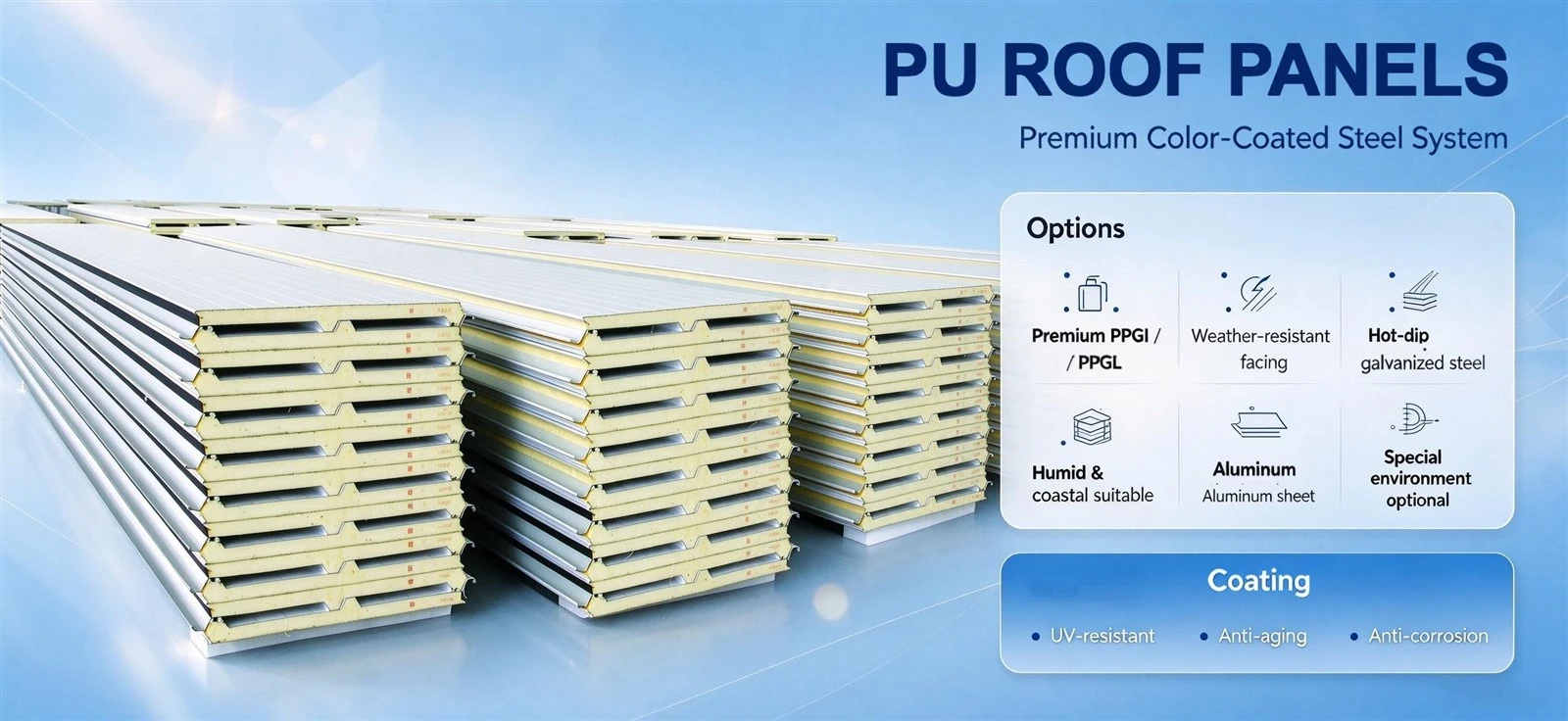
PPGI/PPGL, galvanized, Galvalume, optional Al/stainless |
|
Core Material |
Mineral rock wool to EN 13162; rigid PU confined to the edge seal zone |
|
Panel Thickness |
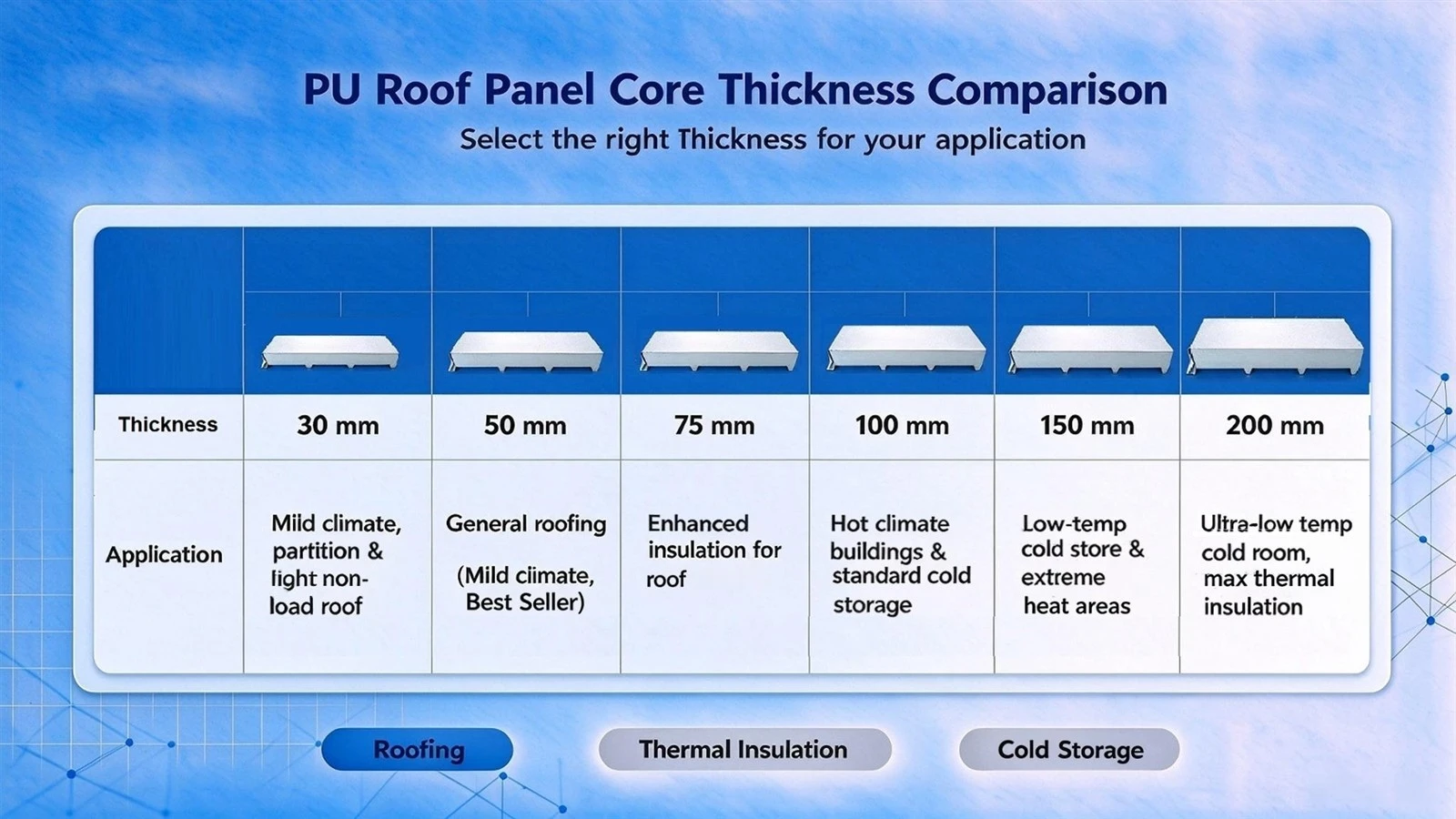
30 / 50 / 75 / 100 / 120 / 150 / 200 mm - 50-100 mm typical here |
|
Sheet Thickness |
0.3–0.8 mm |
|
Width |
950 / 1000 mm (custom available) |
|
Length |
Cut to drawing, maximum 11.9 m for a 40HQ container |
|
Core / Edge-Seal Density |
Rock wool 100-150 kg/m³; PU edge seal 38-43 kg/m³ |
|
Thermal Conductivity |
Rock wool core 0.036-0.040 W/(m·K); PU edge seal 0.022-0.024 W/(m·K) |
|
Water Absorption |
≤ 1.5% |
|
Reaction to Fire |
Euroclass A2-s1,d0 - EN 13501-1 (rock wool build-up); full PIR core B-s1,d0 - verify per thickness |
|
Connection |
Concealed-fixed corrugated / tongue-and-groove, sealed |
|
Custom Colors |
Full RAL including safety and identification colours; light tones advised |
|
Applications |
Port warehouses, fertiliser and chemical plants, food processing, seismic-zone industry |
|
Service Lifespan |
20-25 years with correct substrate, coating and cut-edge sealing |
|
Brand |
QY |
|
Place of Origin |
Liaoning, China |
Performance Parameters
|
Property |
Value / Rating |
|
Core Thermal Conductivity (lambda) |
0.036-0.040 W/(m·K) to EN 12667 |
|
Indicative U-value (core only) |
0.80 at 50 mm; 0.53 at 75 mm; 0.40 at 100 mm; 0.27 at 150 mm - add 5-10% for bridging |
|
Edge-Seal Density / Cells |
38-43 kg/m³, closed-cell ratio >= 90% |
|
Water Absorption |
<= 1.5%; mineral core does not wick if cut edges are sealed |
|
Recommended Substrate |
Galvalume AZ150 for coastal and industrial atmospheres; Z275 inland only |
|
Corrosion Evidence |
Salt-spray (ASTM B117) data and coating mass per coil supplied with each order |
|
Service Lifespan |
20-25 years in coastal/industrial exposure with correct specification and washing |
How to choose the panels as the thickness?
Across most of South America the design driver is condensation control and summer heat gain rather than winter loss, so thickness sits lower than European buyers expect. From lambda = 0.040 W/(m·K), core-only U-values run roughly 0.80 W/(m²·K) at 50 mm, 0.53 at 75 mm, 0.40 at 100 mm and 0.27 at 150 mm; add 5-10% for joints and fixings. Practical guidance: 50 mm for ambient sheds, 75-100 mm for processed-food buildings where surface condensation is unacceptable, 150-200 mm for genuine cold storage.
Surface Material & Coating Options
|
Option |
Guidance for South American duty |
|
PPGI / PPGL pre-painted steel |
Inland industrial sites with no salt or chemical exposure |
|
Hot-dip galvanized steel Z275 |
Acceptable well inland; we would not specify it within sight of the coast |
|
Galvalume (aluminium-zinc AZ150) |
Default for coastal, port and high-humidity sites; resists cut-edge creep |
|
Aluminium / stainless steel |
Available for fertiliser, food-grade and aggressive process atmospheres |
|
Coating |
PVDF for chemical resistance and UV life; SMP where budget binds; PE internally only |
Color Customization
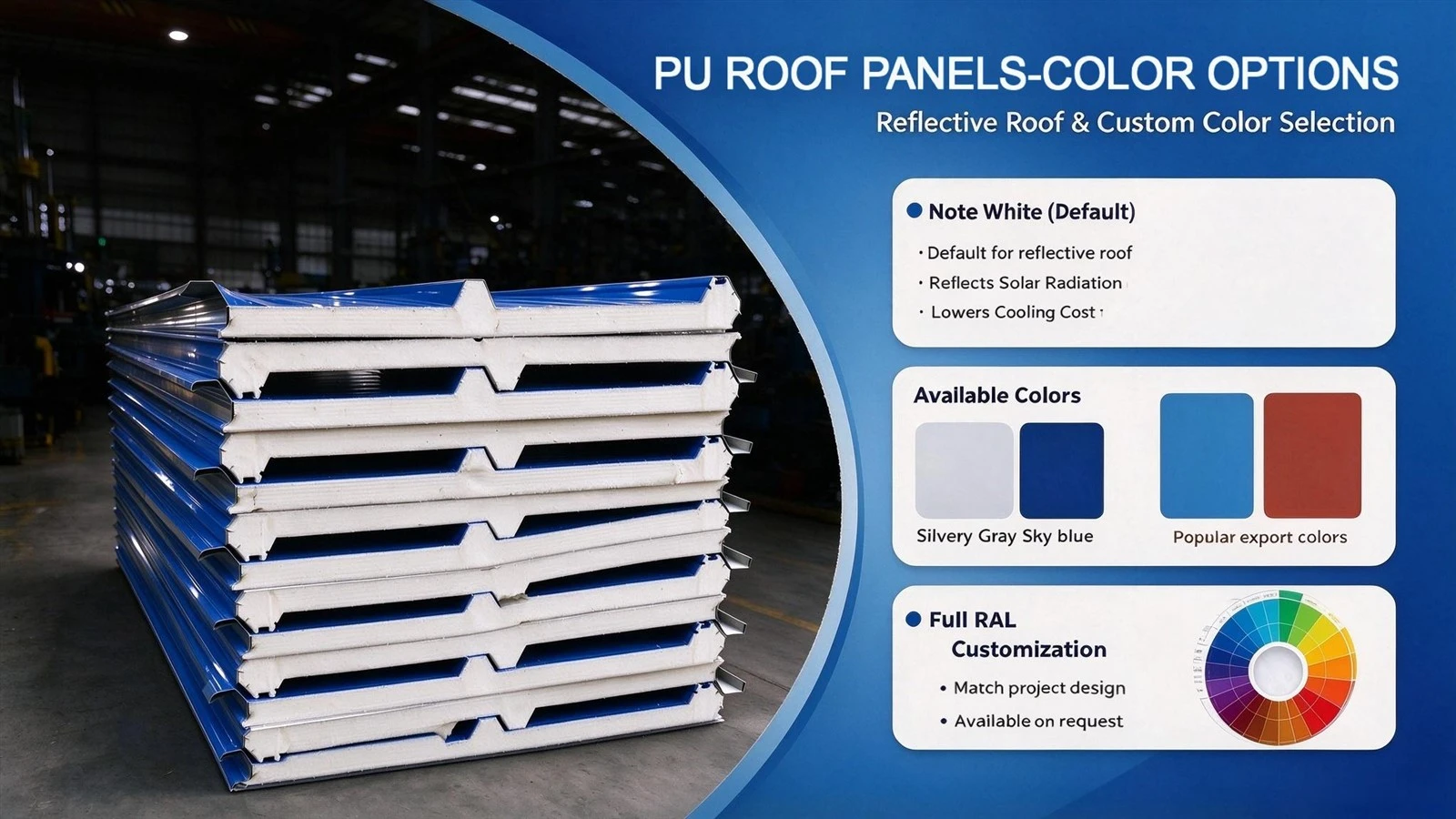
White, light grey, sky blue and brick red are stocked, with full RAL matching available. Colour on this coast is largely a corrosion decision rather than a design one: lighter finishes run cooler, which slows coating degradation, and they make early chalking visible - which is useful, because chalking is the warning sign you want to see rather than miss. Plant operators frequently specify safety colours for walkways and roof plant identification, and we can print these onto the coil.
Application Scenarios
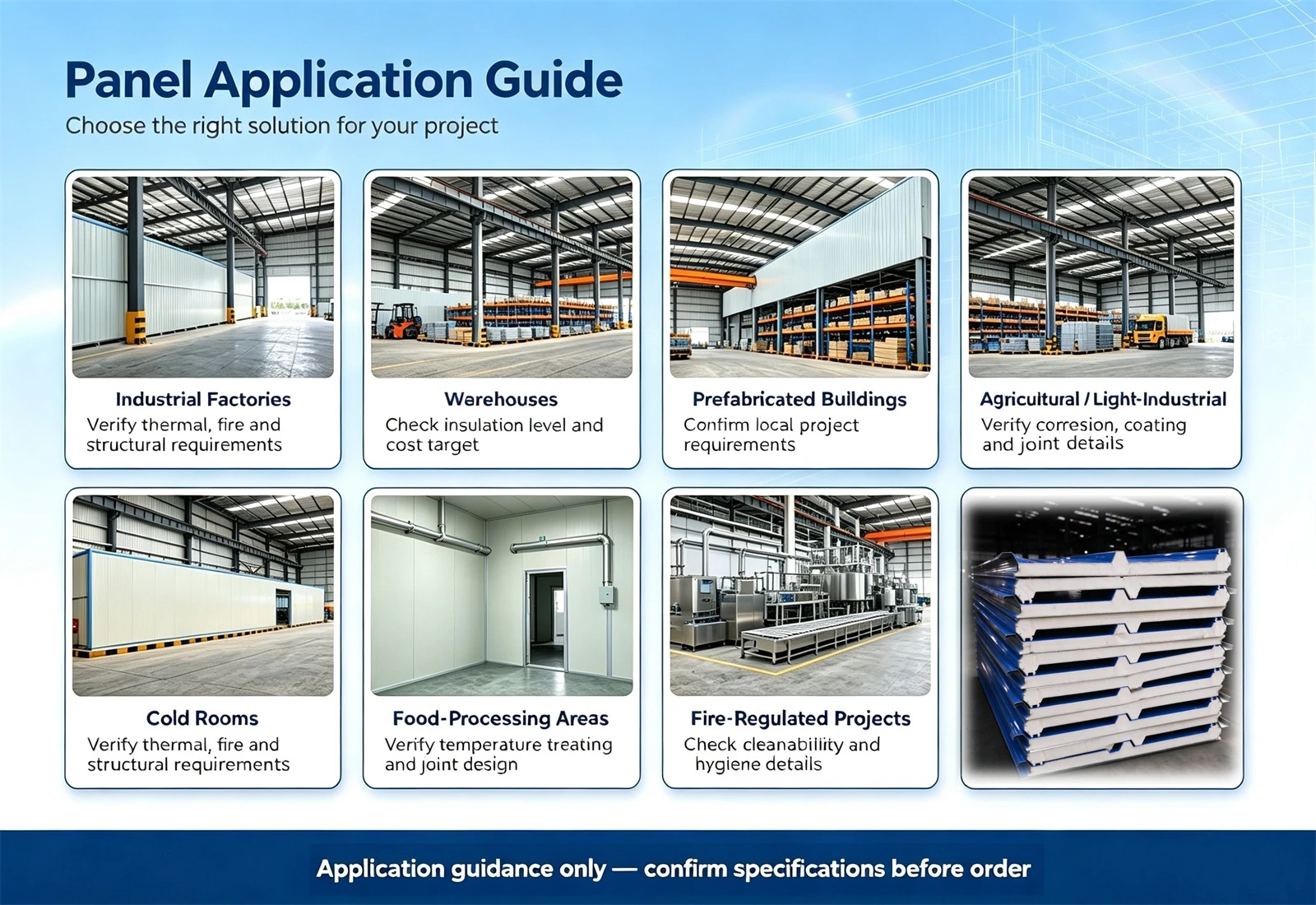
The repeat applications across the region: port-side warehouses and container yards, fertiliser blending and agricultural chemical plants, fish and fruit processing facilities where both humidity and wash-down chemicals are present, automotive and assembly plants on the São Paulo and Cordoba belts, and distribution centres on the Pacific corridor where a lighter roof directly reduces the seismic load case. In each case Galvalume substrate is the default rather than an upgrade.
Target Markets & Climate Fit
The panel is identical everywhere; what changes is the substrate and coating specified against the local exposure class. The table below shows how we configure it for the markets we ship most into, and how often the recommendation differs.
|
Market |
How we configure the panel |
|
Brazil (Santos, Rio, Suape) |
Galvalume + PVDF is standard; kerbside salt and industrial dust both argue against zinc |
|
Chile (Valparaiso, San Antonio) |
Add seismic lightness to the brief; PVDF specified for coastal UV and salt |
|
Peru (Callao, Paita) |
Very dry but highly saline; Al-Zn substrate plus sealed cut edges |
|
Colombia / Ecuador |
Humidity and condensation dominate; thickness sized for dew point, not for U-value |
|
Argentina (Bahia Blanca, Rosario) |
Grain and fertiliser handling - chemical-resistant coating with regular wash-down specified |
|
Inland / highland sites |
Z275 galvanized with SMP is often sufficient; do not overspend where exposure is mild |
Project Reference
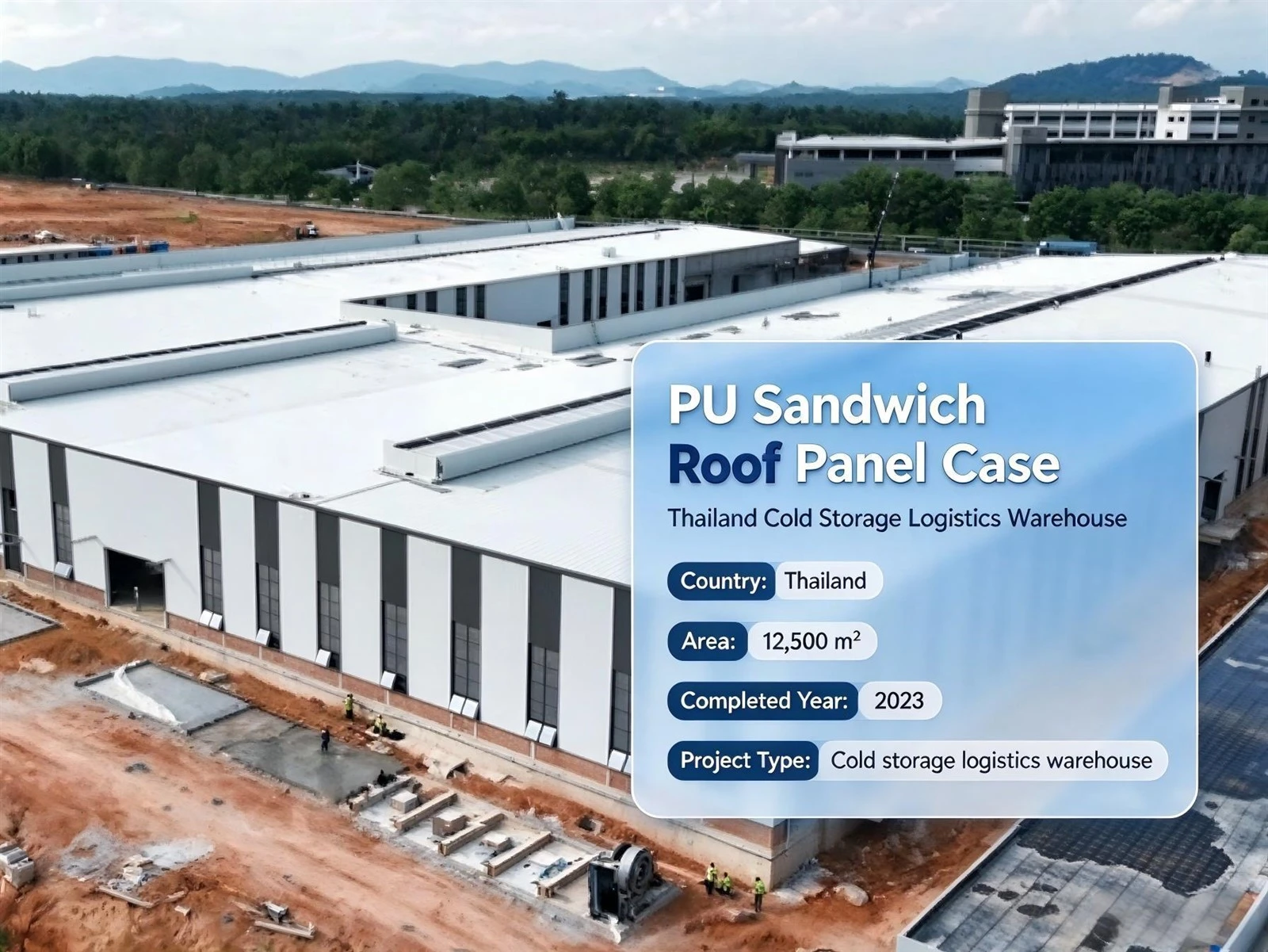
Santos, Brazil - 5,600 m² fertiliser handling and storage facility, delivered 2022. The previous galvanized roof had perforated along the laps inside four years; between the salt air off the estuary and ammonia in the dust, standard zinc coating had no chance. We supplied 75 mm panels on aluminium-zinc (Galvalume) substrate with PVDF topcoat, specified specifically for chemical resistance rather than for cost, and detailed the fixings with sealing washers matched to the rib profile. Every field cut was required to be sealed as a condition of the installation note we issued with the panels - unsealed cut edges are the single most common source of premature corrosion, and it happens on site, not in the factory. Eighteen months on there is no reported roof perforation. Shipment records and substrate certificates for the order are available on request.
Customization & OEM Service
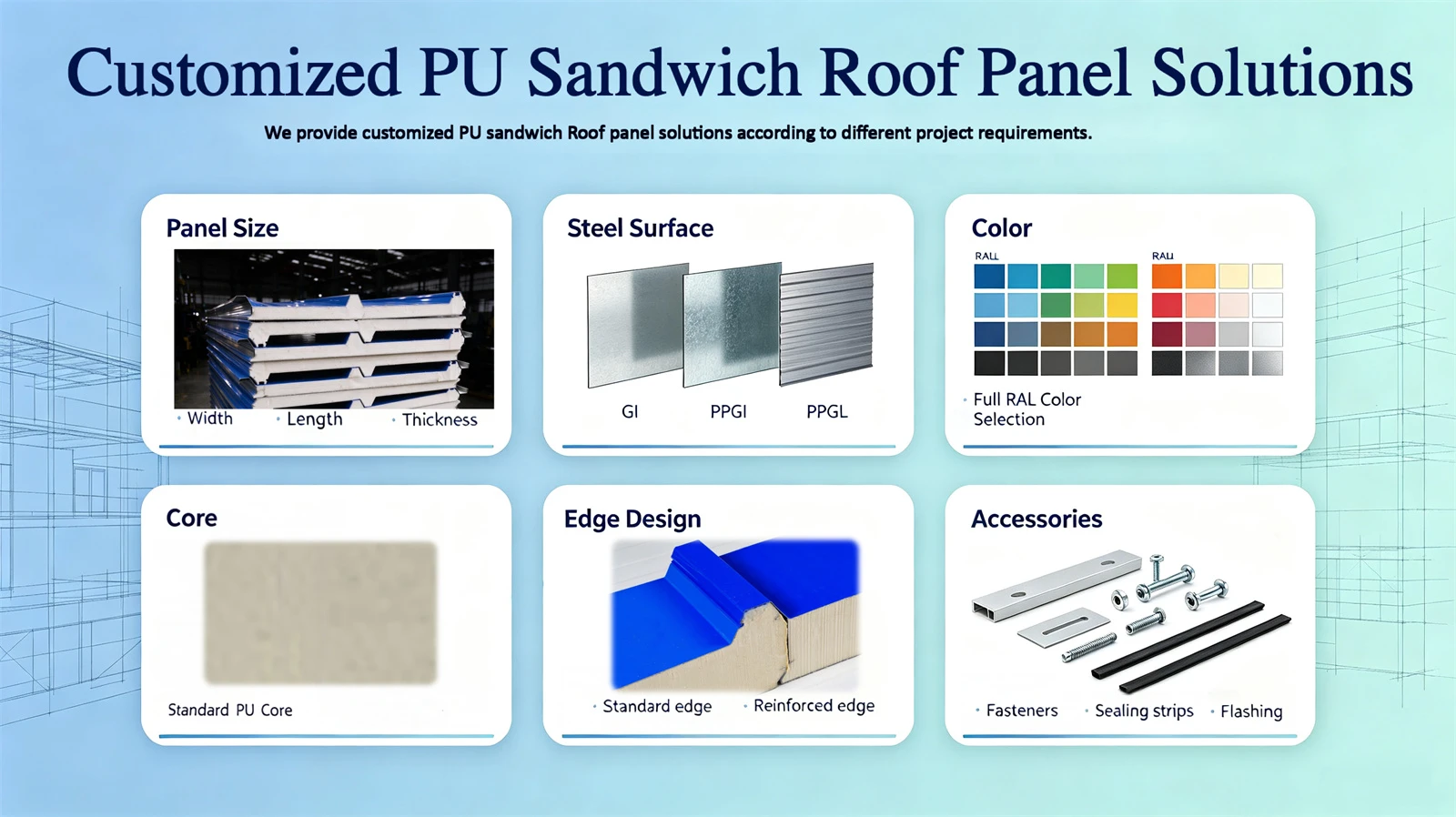
Thickness 30-200 mm with the corresponding U-value calculated for the core; galvanized or Galvalume faces in any RAL colour; PVDF or SMP topcoat selected for the exposure; length up to 11.9 m; concealed or through-fixed; pre-cut slots for skylights, vents and purlins so that no one has to cut panels on the roof and leave a raw edge. MOQ starts at 500 m² for stocked specifications and at one 20GP container for custom profiles; cut samples leave in two to five working days. We include a cut-edge sealing note with every shipment, because that one detail determines whether the warranty means anything.
Certifications & Compliance
For South American submissions the certificate set is usually reviewed by a local engineer, so it needs to be legible rather than merely present: EN 13501-1 reaction-to-fire classification for the build-up ordered, EN 13162 conformity for the mineral wool core, EN 14509 for the assembly, EN 12667 thermal conductivity, and the mill certificate for every coil stating substrate type and coating mass - which is the document that actually settles a corrosion claim. Where a project follows Brazilian ABNT NBR, Chilean NCh or Argentine IRAM provisions, we say plainly which clauses our test reports cover and which need local verification. The plant runs to ISO 9001, ISO 14001 and ISO 45001.
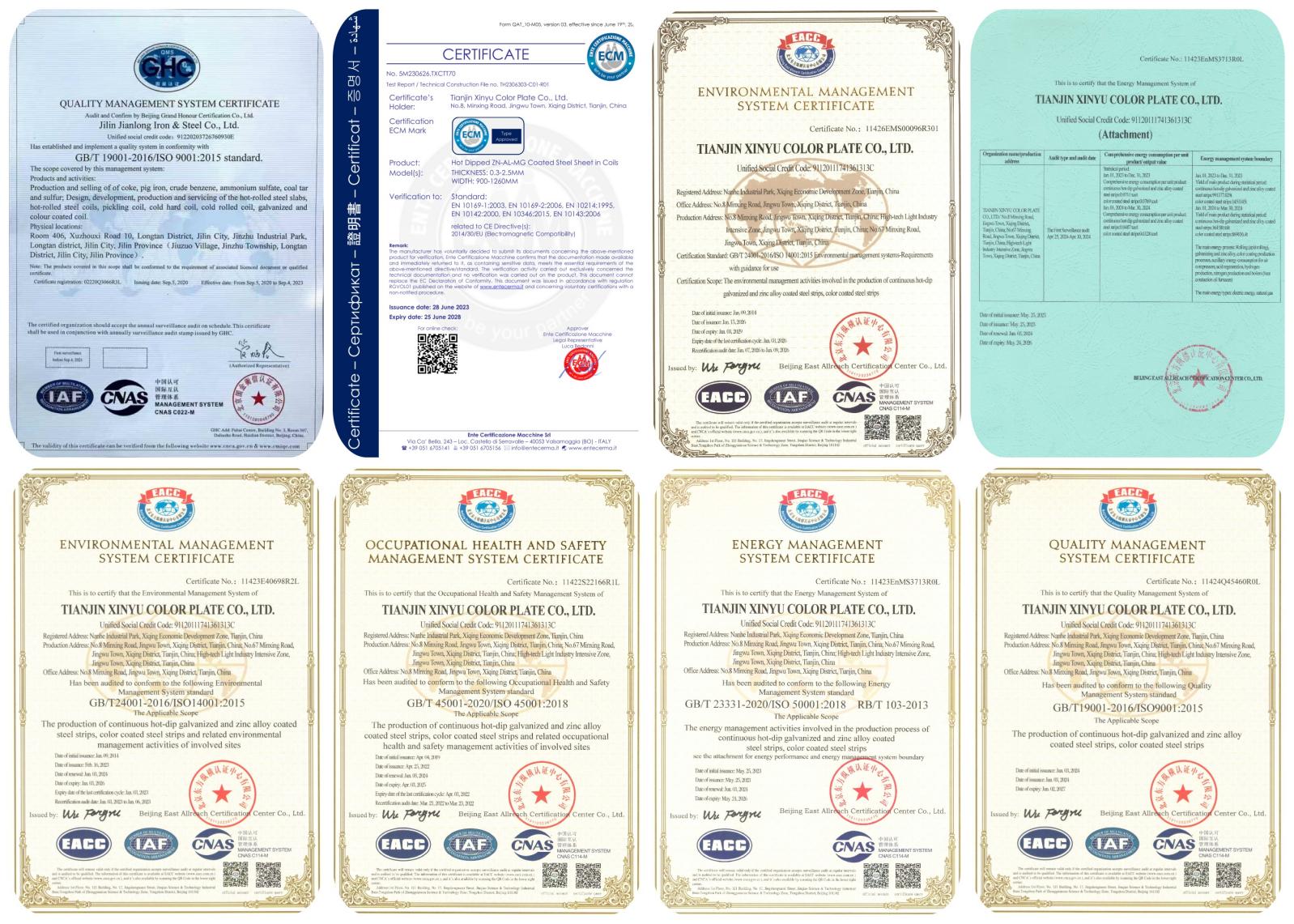
Manufacturing Strength & Quality Control
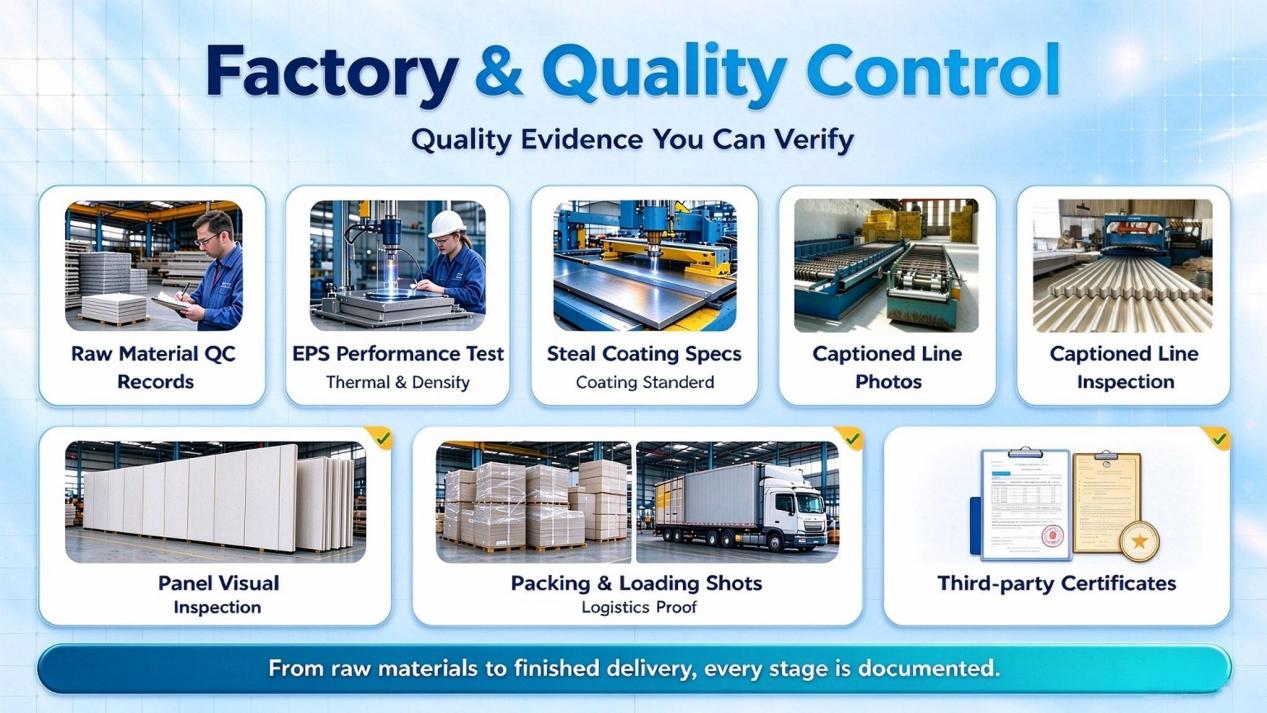
- Experience: shipping since 2010 into Brazil, Chile, Peru, Colombia and Ecuador alongside Southeast Asia, Africa and the Middle East.
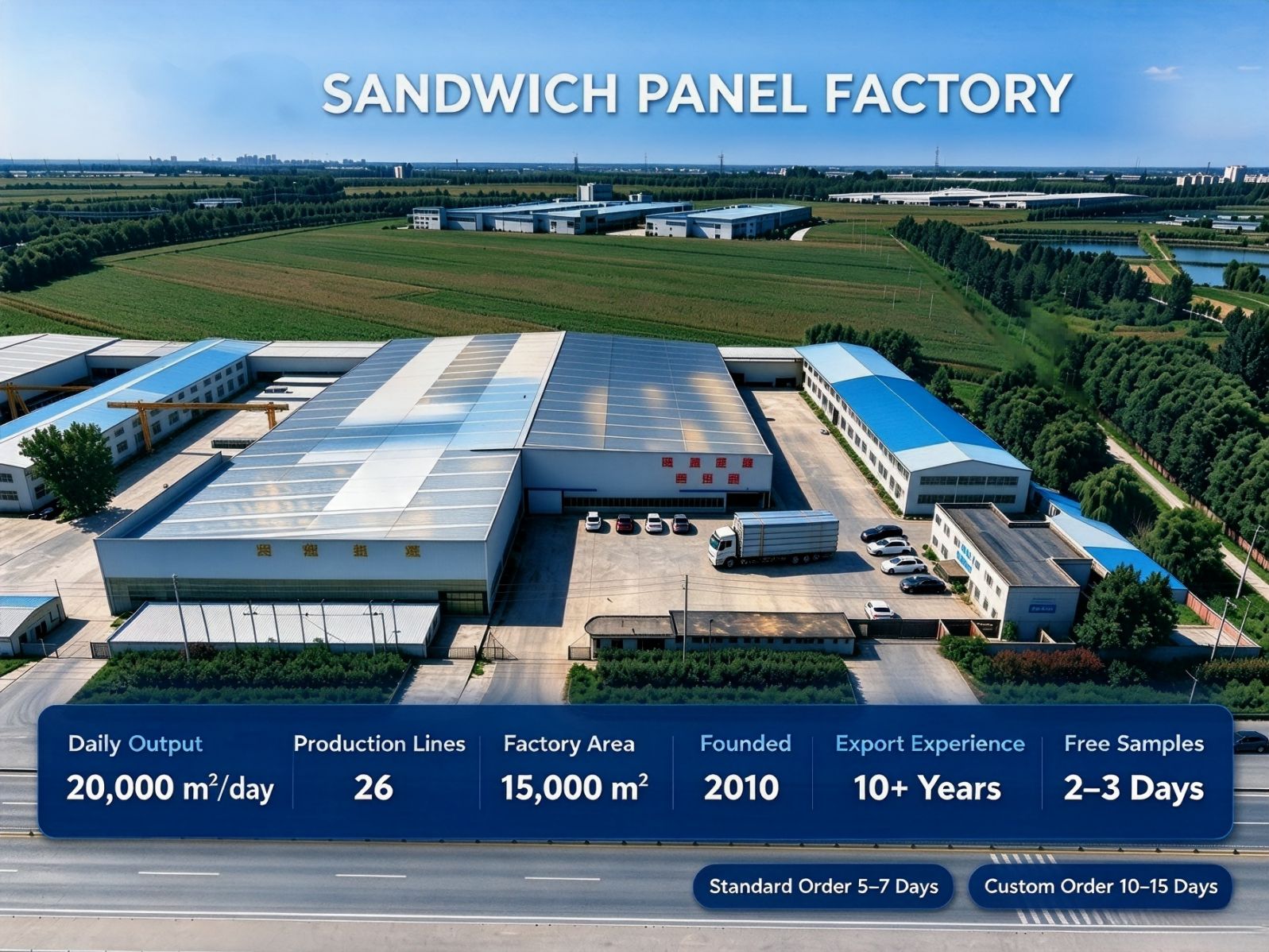
- Production: a 15,000 m² works running 26 lines at approximately 20,000 m² per day on a continuous laminating line - coil levelling, roll-forming, foaming, curing and cut-to-length in one pass, which is why core density is uniform end to end.
- Substrate control: every coil is checked against its certificate for alloy, coating mass and thickness before it is uncoiled, because substituting a lighter zinc coating is a saving that becomes your problem in year three.
- Corrosion-focused QC: bond strength tested to failure per shift, plus dimensional tolerance and panel flatness; salt-spray (ASTM B117) results for the specified coating system are available on request.
- Export packing: full-surface protective film, edge protectors, fumigated pallets and desiccant for long Pacific transits where containers sit in humid ports.
- One-stop service: written quotations within one working day including a corrosion specification recommendation, plus documents prepared for customs clearance at your port.
Lead Time, MOQ & Trade Terms
|
Item |
Detail |
|
Lead Time |
Samples 2-5 working days; 5-7 days for consignments to 5,000 m²; 7-15 days for 10,000-50,000 m²; 10-18 days after drawing approval for custom profile or coating. |
|
Minimum Order |
500 m² for stocked specifications; one 20GP container for custom profiles |
|
Trade Terms |
FOB / CIF / CFR / DDP under Incoterms 2020 for Pacific and Atlantic routings |
|
Payment |
T/T or L/C at sight; terms stated on the proforma invoice |
|
Packing |
Protective film, edge protectors, fumigated pallets, desiccant for humid long-haul transits |
Warranty and After-Sales Service
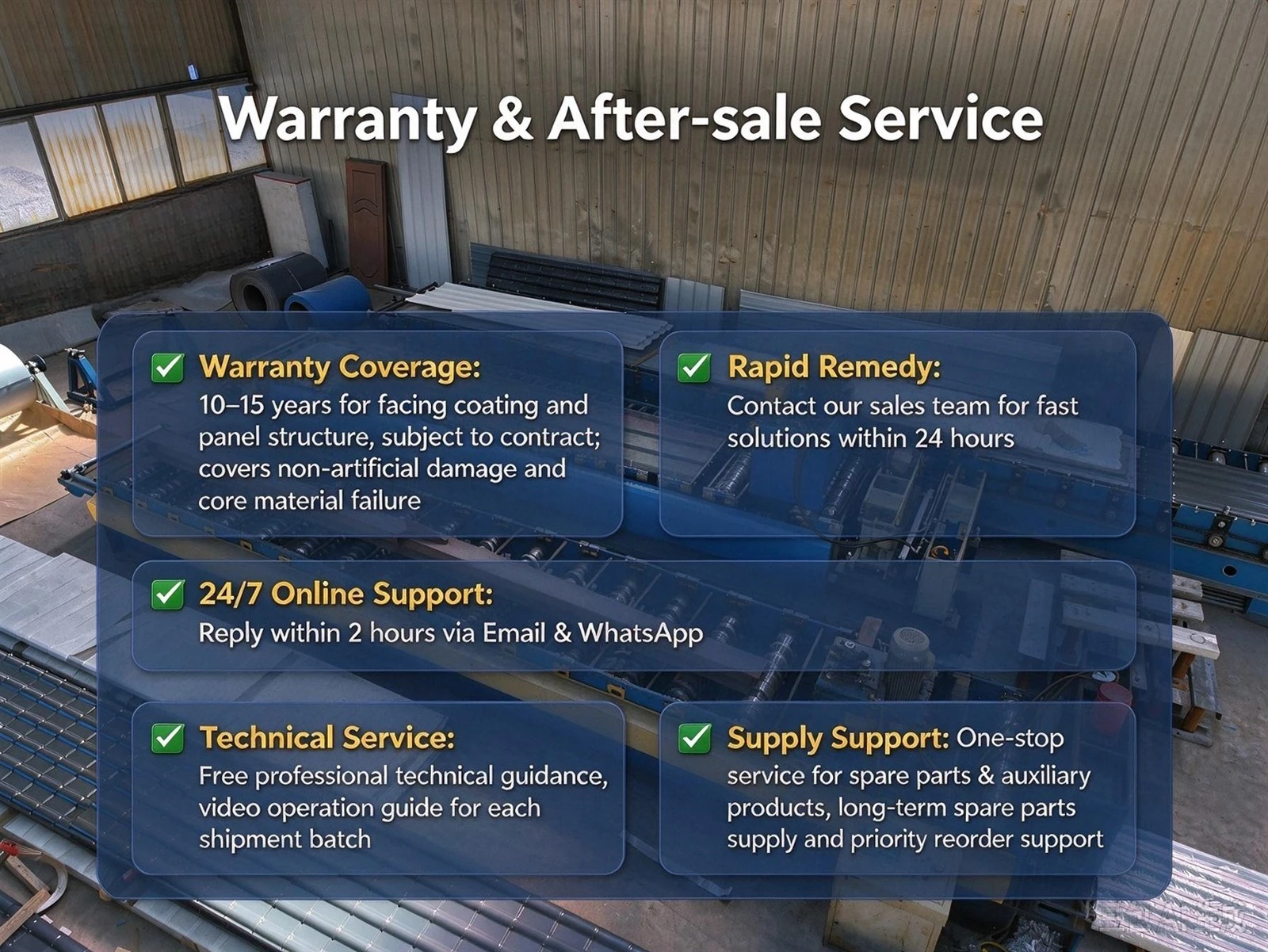
Panels are warranted against delamination and against manufacturing defects in core or bond. The coating warranty is expressed as a term against the specified exposure class and is voided where cut edges were not sealed, where the roof is not washed, or where the specified substrate was changed by the buyer - we set those conditions out up front rather than after a claim. Technical support is available in English, Spanish and Portuguese, responses inside 24 hours, and confirmed defects are replaced or credited before freight is argued about.
Company Profile & Call to Action
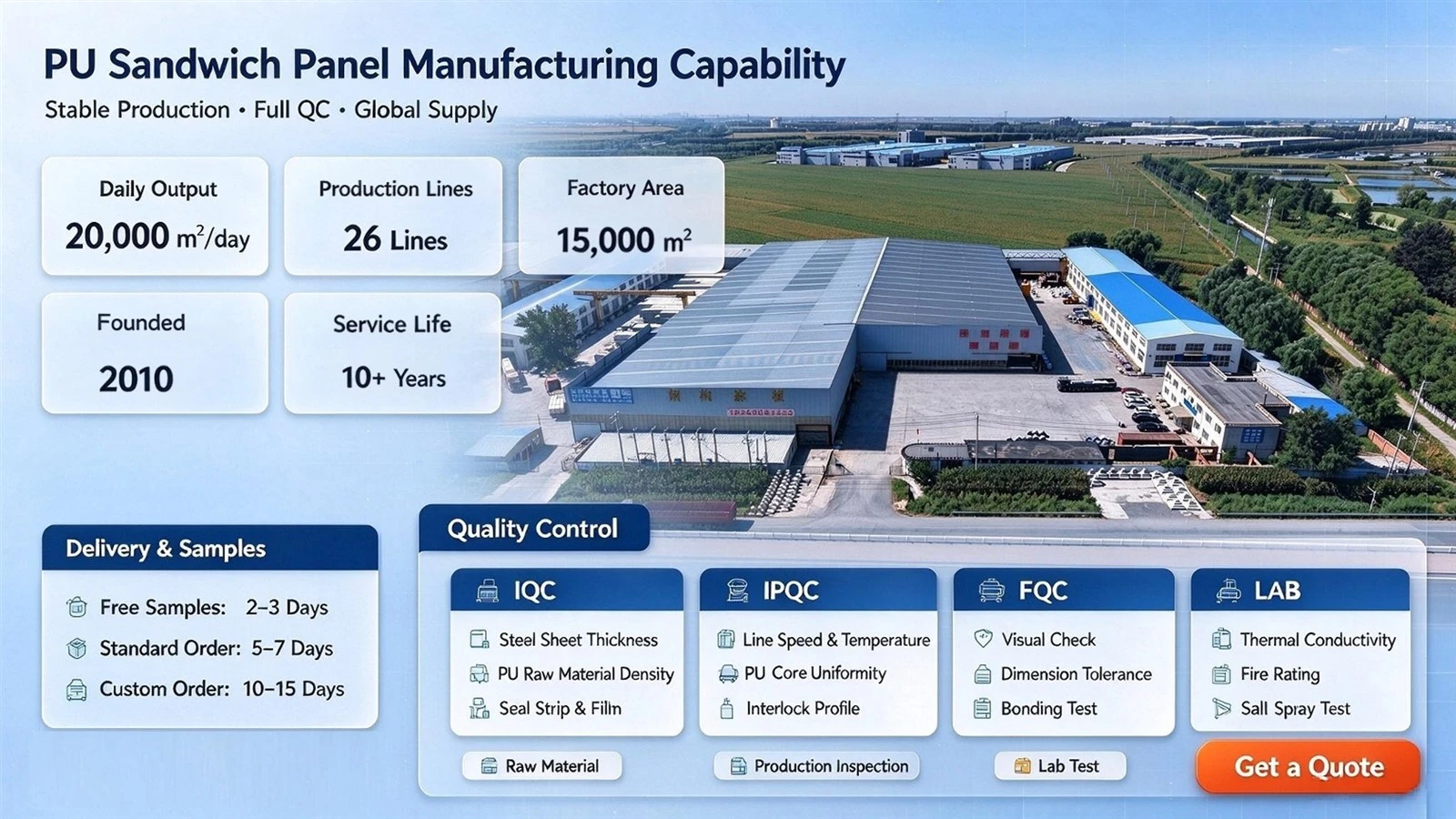
Send us the site location or industrial process, roof area, span and port of discharge, and we will return a substrate and coating recommendation, a thickness with its U-value, corrosion test data and a loaded quotation - usually within one working day. We have manufactured since 2010 in a 15,000 m² Liaoning plant running 26 lines at roughly 20,000 m² per day. And if your process atmosphere rules out steel altogether, we will say so rather than sell you a roof that will be perforated in four years.
Related Sandwich Panel Products
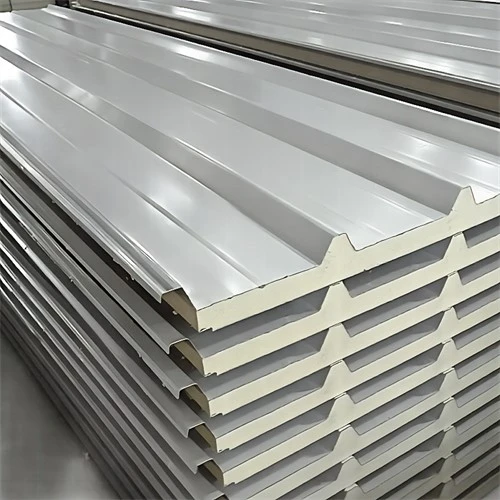
Ranking cores by lambda alone would mislead you on this coast. PIR insulates best per millimetre and is right for a cold store; EPS is cheapest and acceptable for a low-risk building away from the salt. But where the roof sits over a fertiliser plant or a port warehouse, the decision usually turns on fire: the rock wool core in this panel is non-combustible and carries Euroclass A2-s1,d0, which survives both the insurer and the fire review in a way neither foam does. We manufacture all of them and will quote the alternatives honestly, including what each one costs you in fire compliance.
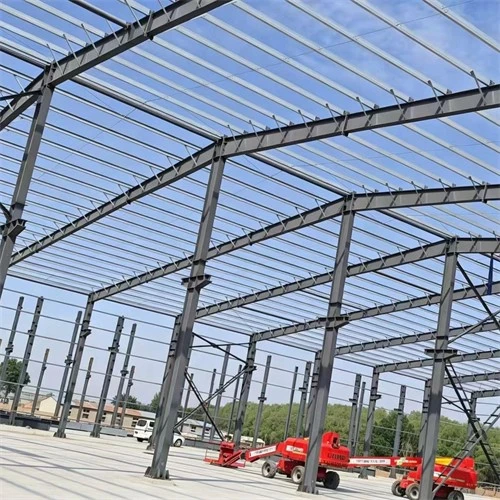
Steel Structure
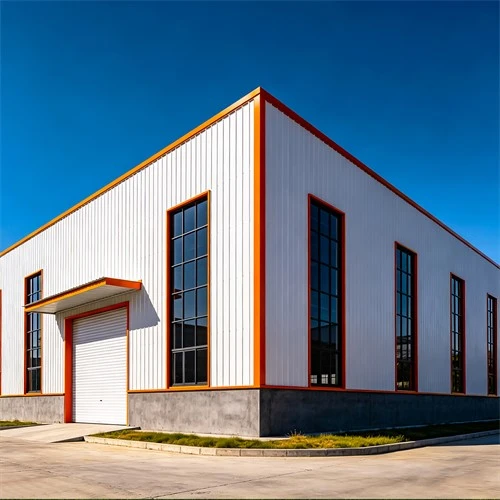
Steel Structure
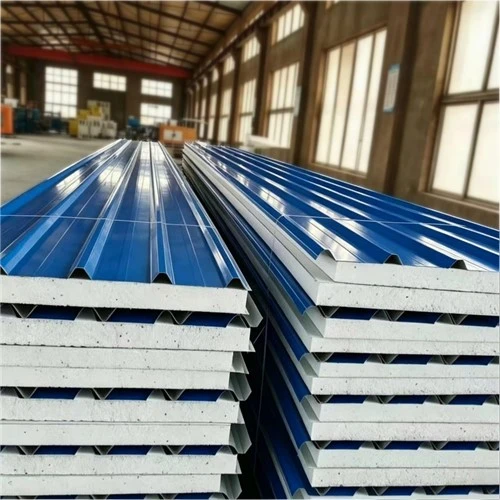
Eps Composite Panels
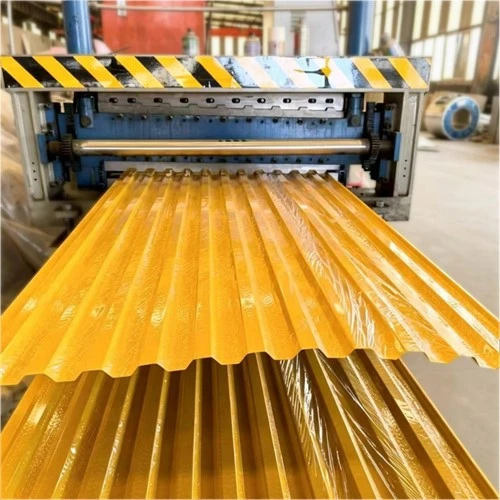
PPGI/PPGL Sheet
Rockwool Sandwich Panels
C and Z purlin
Clean Room Sandwich Panel
PIR Sandwich Panel
PPGI/PPGL Coil
Glasswool Sandwich Panel
Hot Tags: puf insulated roof, China puf insulated roof manufacturers, factory


